

754-234-4789
“Life is too short for an all-beige room”
Luxury Interior Design | Kitchen Remodeling |Home Renovation | Impact Windows
Luxury Design-Build Home Remodeling
& Interior Design
Inspired by South Florida’s 1950s Architecture
South Florida’s 1950s architecture has been updated for today’s
Contemporary & Modern Interiors
This residence was approached through a fully integrated design-build process where architecture, interior design, and the construction process works together to create a cohesive and highly personalized living environment. Originally built in 1957, the home presented an opportunity to reinterpret South Florida’s architectural heritage through a more contemporary lens while preserving the qualities that make homes of this era timeless.
Having grown up in East Fort Lauderdale, I bring a deep personal appreciation for South Florida’s 1950s architecture and interior design. Defined by balanced proportions, graceful transitions between spaces, and a strong connection between indoor and outdoor living, these architectural principles became the foundation for this Modern Traditional renovation.
Rather than treating remodeling and interiors as separate disciplines, every design decision was developed simultaneously from spatial planning and architectural refinement to custom cabinetry, finishes, furnishings, lighting, and final installation. The result is a home that respects its original character while introducing a refined modern interiors designed for the way the homeowners live today.
Modern Mid-Century Kitchen Remodel
Kitchen Remodel “Before”
Prior to the redesign, the kitchen had already received a cosmetic cabinet refacing—an update that improved appearances but did little to address how the space actually functioned. Like putting a fresh blazer on a room that still hadn’t figured itself out. The cabinet refacing elevated the appearance, but good design is rarely skin deep and the underlying layout still wasn’t doing the space any favors.
The kitchen was compartmentalized by a separate laundry room, the layout felt constrained and disconnected from the way the homeowners wanted to live and entertain. Storage was limited, circulation was interrupted, and valuable square footage remained underutilized.
Entertaining was central to their lifestyle, yet the kitchen lacked the openness and ease required to support gathering, cooking, and connecting all at once.
The design solution focused on reimagining the footprint by integrating the adjacent laundry room into the kitchen and creating a more expansive, highly functional environment. The goal was not simply to enlarge the space, but to redesign it with intention by introducing cleaner sightlines, improved flow, and a refined Modern Mid-Century aesthetic tailored specifically to the homeowners’ way of living.
Sometimes the most transformative part of a kitchen remodel isn’t what gets added, it’s knowing what walls no longer deserve to stay.
Kitchen Floor Plan and Space Planning as the Foundation of the Remodel
Designing a Kitchen Around Architecture, Function and Everyday Living
As reflected in our kitchen floor plan, the renovation extended well beyond selecting finishes and cabinetry. Through the strategic removal and addition of walls, relocation of the refrigerator, centering of the range and hood as an architectural focal point, elimination of upper cabinetry, and the incorporation of a dedicated wine bar, custom desk area, and ergonomic design elements, the kitchen was completely reimagined to support the way the homeowners live and entertain.
Together, the client and I developed a kitchen that respects the home’s architectural heritage while creating stronger spatial flow and a more cohesive relationship with the newly remodeled interiors.
With my appreciation for both architecture and interior design, I approach kitchen remodeling as more than a finish selection exercise. The strongest kitchens emerge when architectural planning and interior detailing are developed together while balancing proportion, function, and the way people actually live.
For this renovation, the goal was not to erase the home’s 1950s character but to reinterpret it through a more modern lens. Clean lines, openness, and intentional restraint became the foundation for a kitchen designed to feel timeless rather than trend driven.
Custom Cabinet Fabrication in Our Fort Lauderdale Workshop
For me, custom cabinetry has never been about selecting door styles from a catalog—it begins with understanding how people live and translating that into architecture at a human scale.
Built in our Fort Lauderdale workshop, these custom cabinet components are fabricated with careful attention to proportion, organization, alignment, and long-term performance. At this stage, we refine the details that may go unnoticed visually but define how the kitchen functions every day.
Shown here during fabrication, the cabinetry is assembled before veneers, finishes, and final detailing are applied, allowing us to evaluate workflow, storage, appliance integration, and overall composition before installation.
Good custom cabinetry should feel effortless once complete—but that simplicity is achieved through thoughtful planning long before the first cabinet door is installed.
Reframing the Kitchen Entrance Through Architecture
The kitchen entrance was reconfigured through the strategic addition of walls on both sides, creating the opportunity for the integrated desk area while aligning the opening with the dining room’s window and seating. Architectural columns and crown molding were introduced to frame the view and create a more intentional transition that visually connects the kitchen to the surrounding living spaces.
Custom Kitchen Cabinetry Defining Modern Architectural Character
Custom-designed cabinetry became the framework that established the kitchen’s refined modern identity.
At the client’s suggestion, we eliminated upper cabinetry along the window wall, a decision I enthusiastically supported.
With the addition of the floating shelves next to the window we added balance with matching shelving over the desk. Sometimes great design comes from knowing what not to add.
The result creates a stronger architectural composition while allowing natural light to become part of the design itself. The uninterrupted sightline enhances openness and gives the kitchen a cleaner, more contemporary presence.
Custom Kitchen Storage and an Integrated Wine Bar
By incorporating the adjacent space into the overall footprint, the kitchen gained the opportunity for thoughtful storage planning rather than simply more cabinetry.
A continuous wall of custom pantry storage, a seamlessly integrated built-in refrigerator, and a dedicated wine bar create a highly functional environment while maintaining visual simplicity.
Good kitchen design should make storage feel effortless.
Custom Kitchen Desk and Thoughtful Pet-Friendly Design
Luxury living should accommodate real life.
A custom-designed desk extends naturally into a buffet serving area for entertaining while providing flexible workspace for everyday use.
The homeowners’ Wheaten Terrier, Puck, was also considered in the planning process with a dedicated area integrated into the design—proof that good design considers every member of the household, even the four-legged design consultant.
Ergonomic Kitchen Design as the Foundation of Every Remodel
Every successful kitchen remodel begins with ergonomics.
Before selecting finishes or appliances, I focus on circulation, reach, workflow, and intuitive movement.
For this project, we intentionally challenged the expected dishwasher placement adjacent to the sink and instead flanked the sink with coordinated pull-out waste and recycling systems for improved efficiency and accommodating entertaining events. Oversized vertical black hardware reinforces the kitchen’s architectural rhythm while the remaining cabinets and drawers are absent of any handles creating visual modern continuity throughout this custom kitchen.
One of my signature features in a custom kitchen is the integrated pull-out spice storage within easy reach of the cooking zone because in a well-designed chef’s kitchen, frequently used items should never require a scavenger hunt.
Interior Design Presentation Boards Bringing Materials and Architecture Together
One of the most important stages in interior design and home remodeling happens long before installation begins.
Presentation boards allow clients to see how materials, color, texture, scale, and architectural details will work together as a complete composition rather than evaluating selections individually. Shown here, the living room window treatment concept board combines fabric selections with architectural sketches to study proportion, layering, and how the finished design will relate to the surrounding interiors.
I use presentation boards as a design tool to organize decisions and create clarity throughout the remodeling process. Seeing materials side by side often reveals relationships that are difficult to understand from individual samples alone.
Whether selecting drapery, wall finishes, cabinetry, furnishings, or architectural details, this process allows the design to evolve intentionally, ensuring each element supports the overall vision of the home and the clients expectations. Its much easier and cost effective to make necessary changes on the presentation board.
Good interior design rarely happens by accident. It is developed through thoughtful editing, refinement, and understanding how every material contributes to the experience of the space.
What I Like to Call a Gift from the Universe
One of my favorite moments in interior design is when an unexpected change leads to a stronger result than the original plan.
The client and I were initially excited to specify an open-cut and stitched cocoa fabric that would allow the light beige wall behind to subtly show through and accentuate the pattern. Shortly afterward, we discovered the fabric had been discontinued.
What first felt like a setback became an opportunity.
In its place, we found this multi-colored quarter-circle fabric that unexpectedly brought together the room’s entire palette—the warm beige tones drawn from the millwork, the soft blues from the walls, the dark blue-gray to ground the room, and natural tan accents that added warmth and depth.
The result introduced far more richness, color, and texture than the original solid fabric ever could have achieved.
Sometimes great design comes from careful planning. Other times, the Universe quietly reminds you to keep looking.
Layering Pattern and Texture to Connect the Dining and Living Spaces
For the dining area, I selected a warm golden-tan fabric for the Roman shade and paired it with a wallcovering featuring a modern bronze-gold pattern outlined in brown to create continuity with the living room drapery.
Reupholstering a Favorite Sofa Through Color, Performance and Tailored Detail
The client shared that their dog had claimed the existing sofa as a favorite place to relax, making durability just as important as aesthetics. Rather than replacing a piece that already worked for their lifestyle, we chose to reupholster it and give it a new life.
I selected this highly durable striped fabric because it quietly pulled together the palette already established throughout the home while layering the soft blues from the walls, warm golden tones from the window treatments, natural neutrals, and deeper charcoal accents into a single composition.
To further refine the silhouette, I designed the self-welt that traces the shape of the sofa and emphasizes its tailored lines while adding visual structure and helping maintain cleaner cushion definition over time.
Good upholstery should feel comfortable enough to live in, durable enough to enjoy, and beautiful enough to elevate the room.
Layering Architecture, Texture and Color to Create a Cohesive Living Environment
This living room was designed as an extension of the architectural language established throughout the remodel—where interior design, material selection, and thoughtful detailing work together to create spaces that feel refined, comfortable, and connected.
The custom window treatments became an important starting point in establishing the room’s palette. Roman shades and drapery were developed to introduce warmth, soften the architecture, and frame the exterior views while contributing subtle pattern and texture. The layered fabrics draw together soft blue-grey tones, warm beige, natural tan, and bronze accents that quietly repeat throughout the adjoining spaces.
Wallcoverings were selected to add another layer of texture and warmth while complementing the surrounding millwork and architectural detailing. Together with the crown molding, lighting, and furnishings, the result is a room that feels balanced and collected rather than overly coordinated.
For me, the strongest interiors are rarely defined by a single statement piece—they emerge through the relationship between architecture, materials, and the way people actually live in the space.
Transforming the Fireplace into an Architectural Focal Point
The fireplace surround was redesigned with a rich warm gray finish to introduce depth and contrast while allowing the artwork and its surrounding moldings to create an extended visual frame, with the lighting becoming part of the overall composition. Architectural wallcovering, symmetrical sconces, and flanking chairs reinforce the fireplace as a destination within the space.
For me, successful remodeling is rarely about adding more—it is often about editing, simplifying, and allowing the architecture to speak more clearly.
Designing a Great Room Through Architecture, Proportion and Flow
Modern Mid-Century Space Planning for Connected Living
Every successful remodel begins by creating the right architectural foundation before introducing furnishings, color, and decorative layers.
For this Modern Mid-Century great room, the design process focused first on proportion, openness, and establishing a stronger relationship between the connected living spaces.
For me, great rooms should feel less like separate functions assembled together and more like one cohesive environment designed around the way people live.
Refining the Mid-Century Wall Unit Through Simplicity and Architectural Restraint
Presentation drawings play an important role in my design process by allowing clients to compare ideas and understand how architectural details influence the overall feeling of a space.
Shown here, the original wall unit concept evolved into a more streamlined interpretation that better reflected the direction of the remodel and the home’s Mid-Century influence. Rather than relying on heavier detailing and segmented elements, the revised design simplified the composition through cleaner lines, balanced proportions, and a stronger horizontal emphasis.
For me, the strongest built-ins should feel as though they belong to the architecture of the home rather than appear as furniture placed against the wall.
Reinterpreting 1950s Architecture Through a Modern Mid-Century Wall Unit
Custom cabinetry finished in walnut was selected for its natural grain and warmth, introducing texture and authenticity while reinforcing the horizontal emphasis often found in 1950s architecture. Rather than competing with the architecture, the cabinetry was designed to feel integrated into the room and function as part of the home itself.
As a nod to the home’s heritage, I incorporated a 1950s-inspired decorative panel to conceal the window and transform a functional element into a unique architectural feature and piece of artwork. The panel preserves natural light while introducing pattern, depth, and visual interest without disrupting the clean, streamlined composition.
For me, the strongest interpretations of Mid-Century design are not literal reproductions—they preserve the spirit of the original architecture while creating spaces that feel refined and relevant for modern living.
Where Design Intent Becomes Custom Cabinetry
For me one of the most rewarding stages of the design process is seeing architectural ideas transition from drawings into fabrication.
Shown here in our custom cabinetry workshop, production is underway as the design intent begins to take physical form. Every dimension, proportion, reveal, and alignment established during the design phase is carefully translated into custom-built cabinetry and architectural elements.
For me, this stage is where design and craftsmanship become inseparable. It allows us to verify scale, refine details, and ensure the final installation reflects the original vision rather than becoming a series of field compromises.
The goal has never been simply to build cabinetry—it is to create architectural elements that feel integrated, intentional, and designed specifically for the way our clients live.
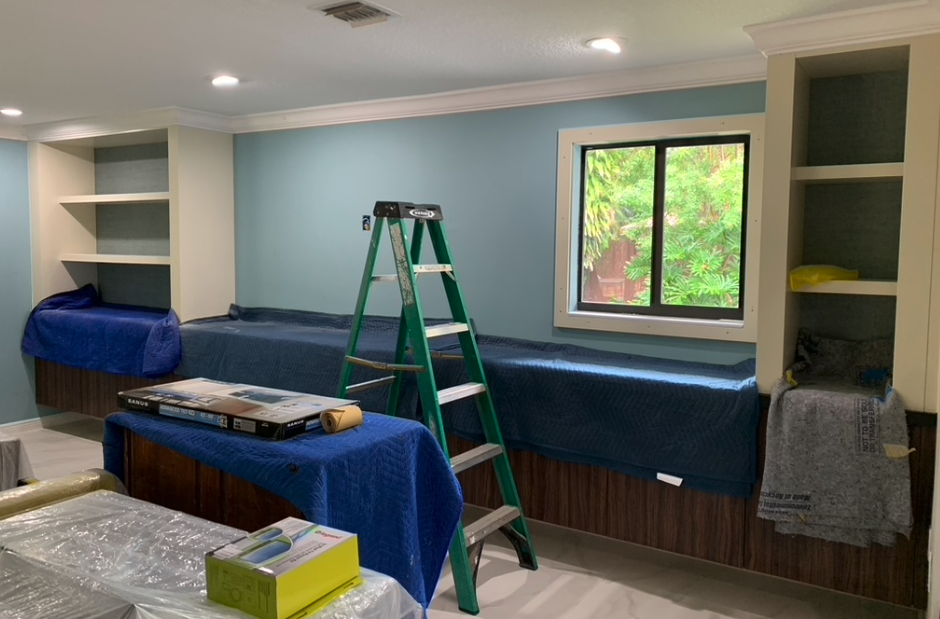
Completing the Architecture Through Custom Millwork and Finish Carpentry
With the custom wall unit fully installed, the next phase focused on completing the architectural detailing that visually connected the entire great room.
At this stage, our carpenter completed the window casing and continued the crown molding throughout the space, allowing the Mid Century custom cabinetry, built-ins, and architecture to read as one cohesive composition rather than individual elements added over time.
For me, finish carpentry is where many home remodels are either elevated or compromised. The careful alignment of moldings, transitions, and architectural details creates continuity, reinforces proportion, and gives the room a more intentional and refined appearance.
Although subtle, these finishing details are often what transform a home’s remodeled room into a space that feels original to the home and fully resolved.
Custom Mid-Century Modern Wall Unit
Designed and fabricated in our custom cabinetry workroom, this wall unit reflects the clean lines and functional simplicity of 1950s Mid-Century Modern design. The existing window was seamlessly integrated with a light panel, creating a balanced architectural composition that feels intentional and refined. Warm wood tones and open shelving reinforce a timeless aesthetic while honoring South Florida’s Mid-Century interior design heritage.
Creating a Destination Through Intentional Dining Room Placement
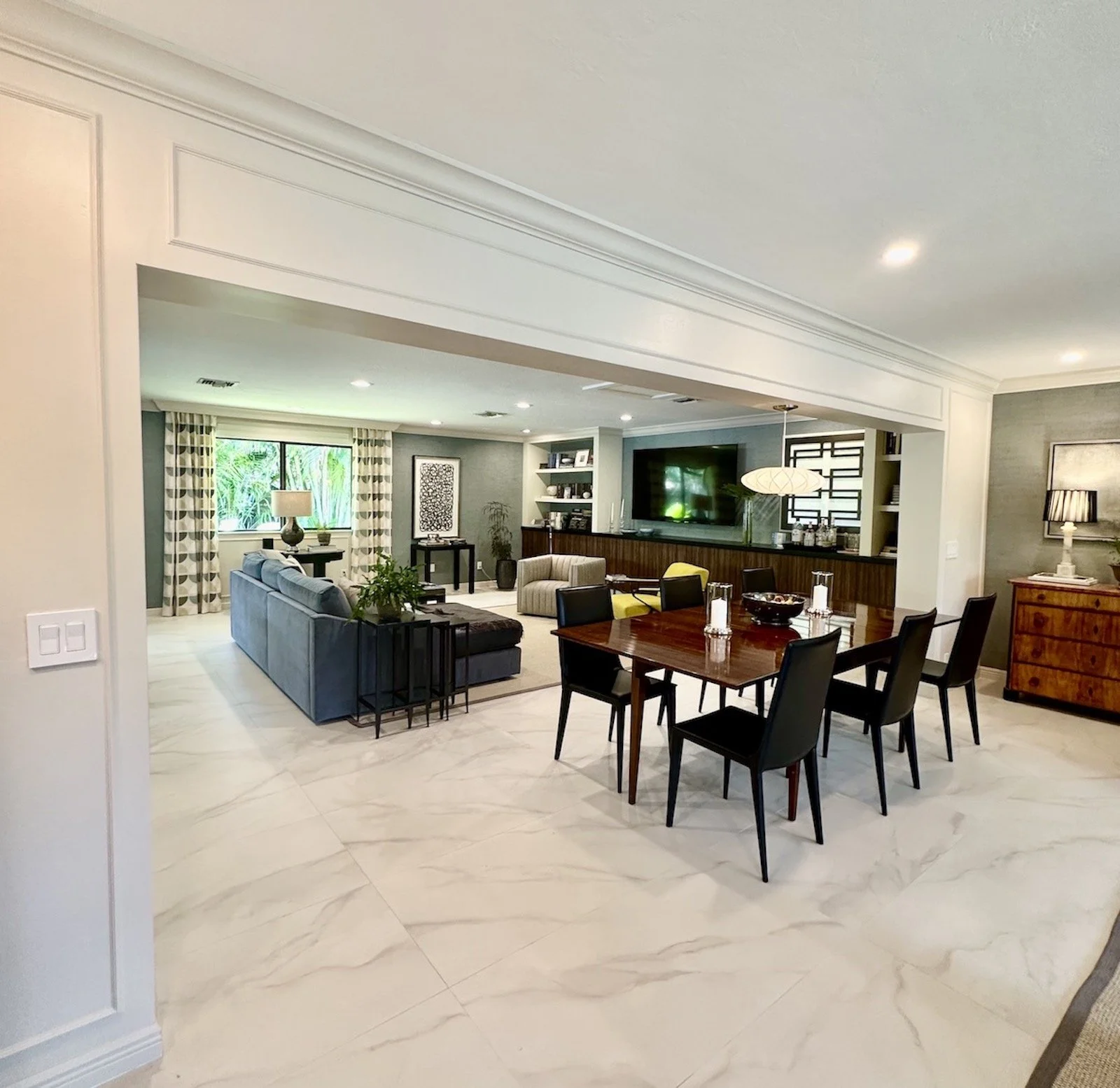
Where to put the dining table?
Borrowing a line from Mommy Dearest and applying it with my own design-driven drama,
I instructed my clients to “put a dining table where it ought to be.”
The dining table was intentionally placed centered on the archway, creating a clearly defined third seating area and servicing both the living and family areas.
A Dining Table Where It Ought to Be
Rather than pushing the dining area to the perimeter, the table was intentionally placed centered on the architectural archway, establishing a purposeful destination within the open plan. Positioned in the middle of the room, it creates a clearly defined third seating area while naturally servicing both the living and family spaces. This placement reinforces circulation, encourages connection, and gives the great room a stronger sense of order and balance.
Creating Distinct Living Zones Within a Modern Mid-Century Great Room
One of the goals for this remodel was to create a great room that felt open and connected while still allowing each area to have its own identity and purpose.
Rather than relying on walls to define function, the space was organized through furniture placement, architectural framing, lighting, and material layering. The living room, conversation area, and dining space were intentionally arranged to create distinct destinations while maintaining clear circulation and visual continuity throughout the home.
Custom architectural details, layered window treatments, integrated millwork, and a restrained palette of warm walnut, soft blue-grey tones, textured wallcoverings, and tailored upholstery establish a sense of balance without feeling overly formal.
I often think of great rooms less as one large room and more as a collection of experiences—spaces designed to encourage gathering, quiet moments, entertaining, and everyday living while still feeling connected as a whole.
And of course, the final measure of success may be when even the family dog decides the room is worth settling into.
Architectural Moldings Define the Space
To further enhance this architectural moment, applied molding was introduced, and the entire wall was painted in the same warm tone as the baseboards and crown molding. This monochromatic approach allows the detailing to read as true architecture rather than surface decoration, creating a strong, timeless statement that feels both intentional and refined. Together, the centered furniture placement and layered millwork transform the open space into a composition that feels curated, architectural, and enduring.
Modern Tropical
Bedroom, Office, and Bathrooms
Guest Bedrooms Are the Perfect Place to Be Bold
Guest bedrooms are one of my favorite places to take design risks and introduce unexpected color. Wrapped in a vibrant green, these spaces feel fresh, welcoming, and full of personality while still maintaining a sense of calm and comfort. Layered with graphic textiles, collected artwork, and tailored furnishings, the rooms create a memorable experience for guests—proof that smaller spaces are often the perfect place to be daring with color.
A Whole New World of Wall Coverings
Primary Bathroom Goes Tropical and Unexpected
There is a whole new world of wall coverings. My client had almost selected this tropical wallpaper in their previous home, so bringing it into the Primary Bathroom felt meant to be. Rich in color and pattern, it transforms the space into an unexpected retreat and proves that bathrooms can be both functional and expressive.
Guest Bathroom is Modern Tropical
For the Guest Bathroom, I envisioned a bold black-and-white tropical graphic—something more modern, playful, and dramatic. Thanks to my wallpaper representative and a little help from the universe, we found exactly the right pattern to bring the vision to life. Together, these spaces show how wallcoverings can become architecture, atmosphere, and personality all at once.
View Full Fort Lauderdale Interior Design & Home Remodeling Projects
For additional information, explore: